
The Working Capital Crisis Inside the AI Transition
Why the shift from per-seat software to consumption-priced AI has produced a structural mismatch between when revenue arrives and when compute cost is incurred

I. The Mismatch
Recurring revenue has been the golden child of software economics, where customers signed annual contracts, paid in advance, and vendors recognized revenue ratably while collecting cash on day zero. Deferred revenue pre-funded a cost of service that was effectively fixed. This enabled companies to achieve 80%+ gross margins and investors to use forward-revenue multiples as the underlying unit economics did not move materially across cycles.
However, inference-cost-led applications have rolled in a new regime, where the marginal cost of serving a customer is meaningful and scales linearly with usage. Bessemer’s State of AI 2025 estimates that the fastest-growing companies built natively on foundation models run at ~25% gross margins, whilst The Information reported in October 2025 that Anthropic itself revised its gross margin projection from 60% to 40%.
While the shift’s unit economic implications are well discussed, its working capital impacts are insufficiently studied. Per-seat annual prepay meant businesses ran on deferred revenue, while the per-resolution, per-conversation, per-minute, and per-outcome pricing models that AI has produced reverse the timing. Customers pay in arrears against compute incurred in real time, yet foundation model providers increasingly require prepaid commits, so compute outflows are settled before customer revenue is collected.
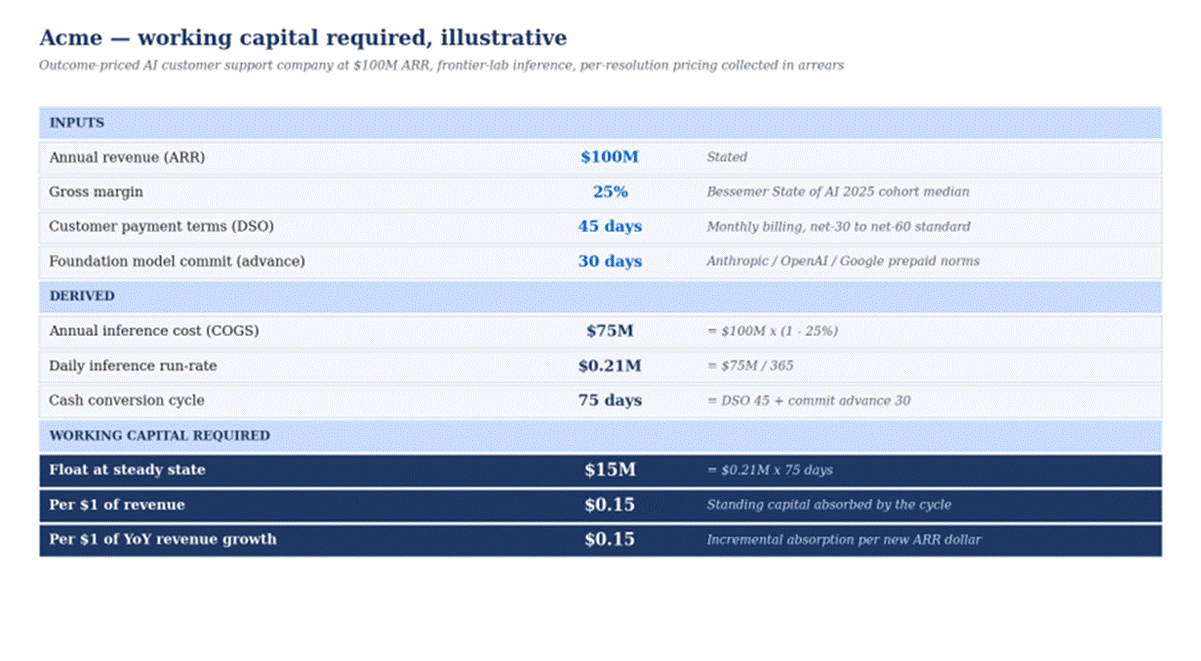
Consider an AI-based customer services agency with $100M of ARR and 25% gross margin. It prepays ~$75M of annual inference cost to a frontier-lab provider 30 days in advance of usage, while collecting customer revenue 45 days after actual usage. The 75-Day cash conversion cycle translates into ~$0.15c per dollar of revenue, that is funded primarily with equity raised at venture multiples. This is a structurally inefficient pairing as investors target venture-like upside (and companies pay the corresponding cost of capital) despite the underlying obligation being a somewhat predictable commodity compute bill. The following image illustrates the math.
This dynamic is not a temporary feature of an early market but a structural consequence of how AI creates value, since companies and customers seek to align incentives through outcomes-based pricing. The deferred revenue cushion that defined a generation of software has, for the first time at scale, become a working capital deficit financed by capital priced for venture-scale upside rather than commodity-scale variable cost.
II. The Private Cases
Sierra has reportedly grown to ~$100M of ARR in under 24-months on per-resolution pricing, while Decagon, Crescendo, Ada, and adjacent competitors have seen similar traction. Across this cohort, the unit of value sold is a deflected ticket or closed conversation, a pricing model that produces direct alignment between vendor compensation and customer outcome.
However, the fixed-fee revenue is funded by variable costs. Each resolution requires multiple model calls (a frontier model for reasoning, a smaller model for routing, embeddings for retrieval, sometimes voice), and industry estimates put inference cost per complex resolution at $0.15-0.40 per $1.00-3.00 of revenue. Per-transaction gross margins are healthy on paper, but cash flow is not, as customers are invoiced monthly in arrears with 30-to-60-day payments terms on volumes that vary with their own traffic, while foundation model costs are billed monthly and increasingly through prepaid commits. A company growing 100%+ YoY (as Sierra) on usage-based revenue is therefore funding the gap between collection and payment with capital designed for growth, and consumes cash faster as it grows even when transactions are gross-margin positive.
We see similar dynamics across others. Harvey, at ~$75M ARR, has a hybrid pricing model that combines per-seat platform cost with usage-priced model calls. The per-seat component partially restores the deferred revenue cushion, but the marginal cost of large-document passes still requires working capital during growth. Glean’s ~$100M ARR is more conventional per-seat, but the company is increasingly absorbing foundation model commit obligations as it expands beyond retrieval into agentic workflows, where seat revenue does not flex with agent inference cost. Hebbia, in financial-services document analysis, faces similar dynamics.
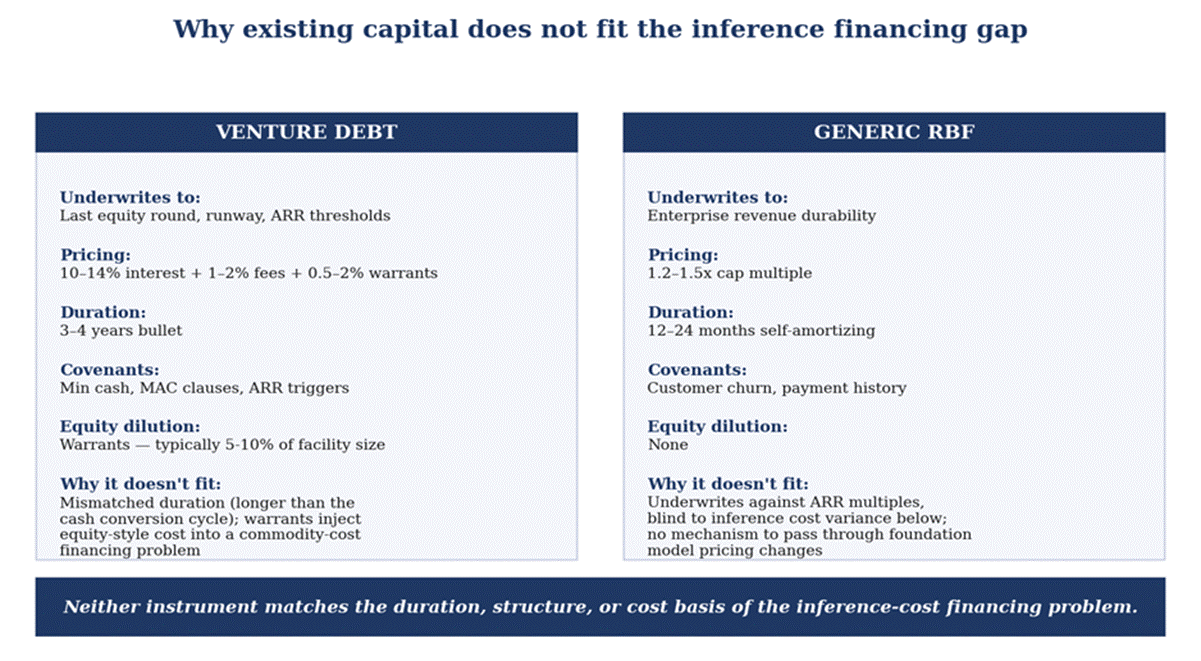
This leads to dilution that is neither operational waste nor poor performance but structural mispricing of capital. Venture-style equity targeting a 3-5x hurdle over its fund life is being deployed against a compute bill that takes far lower risk and targets correspondingly lower upside. The capital efficiency degradation visible in this generation’s numbers, with companies burning more equity per dollar of ARR than the prior generation of software companies did, is in significant part this mismatch expressing itself as dilution rather than as anything wrong with the underlying businesses. Neither venture debt (priced and structured for runway financing, with covenants tied to ARR and warrant dilution attached) nor generic revenue-based financing (which underwrites to enterprise revenue rather than the specific compute cost line beneath it) addresses the gap. More details are in the below image.
III. The Capital That Should Exist
The financing gap that Sierra, Decagon, Harvey, Glean, and the broader frontier-lab-dependent cohort experience invisibly inside private financials sits between a commodity-priced compute obligation incurred in real time and a contractual customer revenue stream collected in arrears. The right way to underwrite that gap is to invest against the customer revenue with inference cost as the asset basis, repaid as a capped share of revenue, structured so that the asset risk is the customer revenue risk rather than the equity risk of the underlying business.
The closest existing precedent is Royalty Pharma, which has compounded at ~14% return on invested capital across its predecessor funds and the public entity since inception by buying pharmaceutical royalty streams. The asset class works in pharma because revenue is contractual, cash flows are predictable, and cost of capital is matched to asset volatility rather than business volatility. The pharma analog also has limits, however; pharma royalty streams enjoy FDA exclusivity and fifteen- to twenty-year duration, while AI revenue contracts are typically one to three years and exposed to model substitution risk, so the right instrument is shorter-duration, faster-amortizing, and dynamically re-underwritten relative to a pharma royalty. General Catalyst’s Customer Value Fund has a similar vision for S&M spend.
IV. Open Questions
This piece is meant as a thesis under open consideration rather than a finished prescription. The structural argument I find most defensible is that the cost of capital being applied to outcome-priced, frontier-lab-dependent AI applications is mismatched to the underlying nature of the obligation being financed, and that the closest existing instruments (venture debt, generic RBF, and primary equity) each miss specific features of the asset basis. Thats said, risks I’d most want pushback on:
• Inference costs are compressing fast enough that the regime change is transitional rather than structural, and the addressable working capital absorbed shrinks accordingly.
• Frontier-lab providers (Anthropic, OpenAI, Google) will absorb the financing problem themselves as a customer acquisition tool.
• GC CVF and AMP Foundry are already deployed at sufficient scale to cover the addressable market, and a new entrant needs a sharper wedge than the diagnosis itself provides.
• AI customer revenue durability is materially less predictable than pharma royalty streams in ways that weaken the cost-of-capital comparison.
• Adverse selection makes the borrower base that takes structured credit systematically lower quality than the universe the thesis assumes.
• AI founders culturally prefer equity, and the demand side never matures regardless of what the supply side builds.
Would love to hear any and all takes! If anyone reading this is thinking about the same problem and wants to build on it, please reach out.